
Software for contract manufacturers

Manage customer specifications, approved samples, materials, production and shipments as one agreed workflow, including repeat batches and subcontracted operations.

We build, launch and maintain your system. Start with one complete workflow.

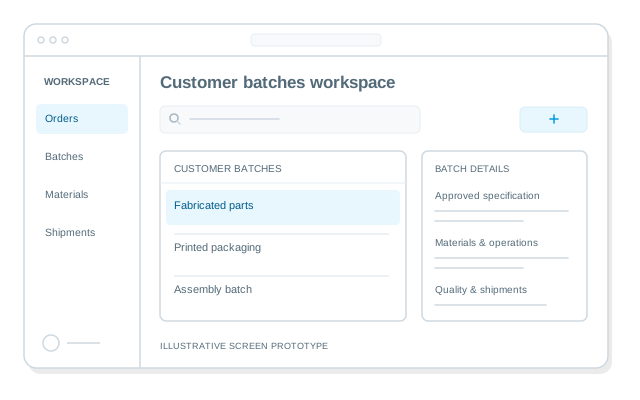
Illustrative screen prototype of a customer batches workspace, showing records and a details panel.

Who this is for

Manufacturers making products or batches to a customer's drawings, artwork, specification or approved sample. Sample preparation and production engineering can be part of the process.

Metal fabrication workshops

You make metal parts and structures to customer drawings and distribute operations across your workshop and subcontractors.

Where your rules matter
  • Each order uses an approved drawing revision. A change needs to reach instructions, purchases and records for the affected parts.
  • Cutting, machining, coating and other operations involve internal teams and subcontractors, with each batch handover and return recorded.
  • Acceptance needs the agreed measurements and product records, connecting quality evidence to the customer's order.

Assembly & contract manufacturers

You assemble products to customer specifications and coordinate components, outside operations and readiness checks.

Where your rules matter
  • Customer specification changes need to update components and assembly work under the right order revision.
  • Customer-owned and purchased materials have different shortage, substitution and balance reporting requirements.
  • Readiness depends on checks defined by the customer, with results connected to serial numbers, deviations and shipment release.

Packaging manufacturers

You develop and manufacture packaging to a customer's construction, artwork and batch requirements.

Where your rules matter
  • Packaging construction, print and samples may need several approvals, with production tied to the approved specification and artwork.
  • Tooling and materials belong to particular customer products; their readiness and permitted substitutions affect batch release.
  • Customers order batches with different dates and document requirements, linking production and partial shipments to each acceptance record.

Feature sets for contract manufacturing.

Explore the published feature groups for this business and learn how they can support your processes.

Feature groups are currently unavailable for this page.

Built around how you work

Your rules for batch release

Define which specification revision, artwork, sample and agreed requirements allow a batch or repeat order to start. Keep the authorised version connected to the work instructions.

Your rules for materials and deviations

Distinguish customer-owned materials from purchased stock and record handovers to outside operations. Agree who can approve a substitution, rework or deviation and its cost and timing before affected work continues.

Your rules for quality and shipments

Set checks, evidence and documents for each customer and product. Keep partial shipments, approved deviations and the remaining batch connected to the acceptance requirements.

Your rules for payments

Set deposits, batch or shipment payments and settlement after acceptance. We can add payment collection and reminders, connecting amounts due to confirmed shipments, approved extra operations and billing records.

Your ERP, stock, production, quality and accounting tools can be part of the plan, alongside customer drawings, artwork and documents. We assess interfaces before agreeing how revisions, materials, operations and shipments will connect.

From workflow to working software

  1. Start with work your team knows

    Tell us how a request moves through your business today, where people have to chase information and what happens when the plan changes. We help turn that into a clear brief. You do not need a technical specification.

  2. Agree a useful first version

    Together, we define a complete workflow, the people involved, the rules and exceptions, and the result it needs to deliver. We agree how to measure improvement, such as rework caused by the wrong revision, time waiting for customer decisions on deviations, and time from batch readiness to agreed shipment.

  3. Review a prototype

    Walk through a prototype using examples from your daily work. Check the normal case, missing inputs, changes and customer decisions, so the system reflects the situations your team actually handles.

  4. Launch and keep it running

    We build, test and launch the agreed system, then provide the agreed ongoing maintenance and support. Data setup, connections to existing tools and the move into daily use are part of the launch plan.

  5. Change it as your business changes

    New services, agreements, approval rules or ways of working can become agreed updates to the system. We clarify the change, assess its effect and agree the scope and price before adding new functionality.

Your brand. A direct connection.

Bring your business closer to your customers

Give customers a direct connection to their orders and repeat batches. almops can build a branded app or portal for specifications, decisions and shipment updates.

Your own customer app

Let customers use an app under your brand to submit an order or repeat request, provide requirements and receive updates about the batches and deliveries agreed with your team.

A customer portal under your brand

Provide a web workspace for specifications, approved artwork or samples, material and deviation decisions, quality documents and shipment records tied to each customer order.

Questions

Can we keep our ERP, stock and production systems?

We can scope the workflow around your current systems. During discovery we check available interfaces, data ownership and practical limits, then agree how specifications, operations, quality and shipment records should connect.

When does a system built around our business make sense?

It can help when customer-specific revisions, material ownership, outside operations or acceptance rules repeatedly require manual work outside your current systems. We review a real order with you and consider ready-made options before proposing a new system.

Do we need a technical specification or a complete replacement system?

You can start by describing one process and showing us how it works today. We ask questions and help define the requirements. A first version can cover one complete workflow, with further additions agreed separately.

Who looks after the system after launch?

AlmOps handles the agreed maintenance and support, and helps develop the system as your requirements change. Your proposal defines the service included and how later changes are handled.

Where is the system hosted and can we use our own server?

Hosting with AlmOps is the default. Deployment on your own infrastructure can be scoped as an additional paid option. We discuss data access, exports and operational requirements while defining the system.

How is pricing handled?

The aim is a predictable monthly payment for an agreed system and service. Your proposal sets out the amount, payment period, hosting, support and any initial charges. Later additions are scoped and priced separately.

Could we run and maintain our version independently later?

You can obtain non-exclusive rights to keep using and changing the paid-for version for your own business after the agreed main payment period or a one-off payment. The handover covers source code, a data export, operating instructions and the rights needed to run the software independently. Licence, handover, hosting and support terms are agreed in your contract.

Start with one process

Start with one customer batch

Tell us how a specification becomes an accepted shipment, which tools your team uses and where revisions, materials or customer decisions get held up.

No technical specification needed. Start with your process.