
Software for made-to-order manufacturers

Manage made-to-order work, from customer requirements and design approvals to production, delivery and acceptance, with the right process for each kind of order.

We build, launch and maintain your system. Start with one complete workflow.

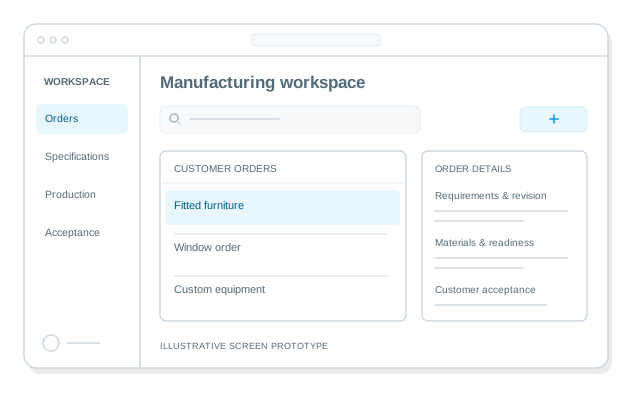
Illustrative screen prototype of a manufacturing workspace, showing records and a details panel.

Who this is for

Manufacturers adapting products to individual dimensions and materials, and businesses designing and building a solution for each customer project. Both ways of working can be part of the same system.

Furniture & joinery workshops

You make furniture and joinery to agreed measurements and specifications and organise delivery and installation.

Where your rules matter
  • Dimensions, materials and fittings change during approval; production needs the order version confirmed by the customer.
  • Measurements, purchasing, manufacturing and installation depend on one another, with readiness and delays visible for each part of the order.
  • A replacement after installation needs the original configuration and acceptance notes, keeping service connected to the delivered product.

Window & door manufacturers

You make windows and doors to the measurements of each opening and coordinate the finished order and its installation.

Where your rules matter
  • Each opening has its own dimensions and configuration, connected to the approved manufacturing specification.
  • A changed profile, fitting or finish affects supplies and dates; only an agreed substitution should reach production.
  • Delivery, removal and installation depend on site readiness. Issues at one opening need a link to the relevant production order.

Special-purpose equipment & production line manufacturers

You design and manufacture equipment or production lines for a customer's technical requirements, then test and hand them over.

Where your rules matter
  • A clarified requirement can change the design and equipment list and needs to reach engineering, purchasing and production instructions.
  • Long-lead components must stay connected to design readiness, deliveries, manufacturing and assembly dependencies.
  • Internal tests and customer acceptance have different criteria, with issues and confirmed results tied to the right milestone and design revision.

Electrical panel & automation system manufacturers

You design and assemble electrical panels, control cabinets and automation systems for customer equipment and sites.

Where your rules matter
  • Changed site requirements after drawing release need to update purchasing, components and assembly instructions together.
  • An unavailable component needs an approved substitution, with its effect on documents, cost and testing recorded.
  • Factory and site checks differ; results and issues need to stay linked to the specific product and customer acceptance.

Engineered structure & modular building manufacturers

You design and make structures or modular buildings around project dimensions, site conditions and customer requirements.

Where your rules matter
  • A geometry or site change can affect several elements, requiring a new approved design and an assessment of its consequences.
  • Manufactured parts, subcontracted work, transport and site readiness depend on one another; a finished element alone does not make the delivery ready.
  • Acceptance follows modules and stages, with issues, rework and additions tied to the design and agreed obligations.

Two ways to make work to order

Individual specifications and engineering projects need different checks and handovers. These two illustrative examples show how each can stay connected from the customer's request to acceptance. The data is fictional and does not represent a finished product.

Products made to individual specifications

For furniture, joinery, windows and doors, connect measurements and options to the approved order version, materials, manufacture, delivery and installation.

If a customer changes a dimension or material after approval, assess purchasing, completed work, cost and dates before affected work continues under the new agreed version.

Customer specification & quote

Order W-204 · Illustrative example

Product
Fitted storage
Measurements
Site survey recorded
Customer decision
Specification to approve

Approved change & impact

Order W-204 · Change approved

Request
Different door finish
Impact
Materials, price and date reviewed
Order version
Revision B confirmed

Production & installation readiness

Order W-204 · Readiness review

Production
Revision B completed
Delivery
Fittings checked
Customer site
Installation access confirmed

Acceptance & final handover

Order W-204 · Accepted

Installed product
Configuration recorded
Issues
Correction confirmed
Final account
Approved change included

Products designed and built for each project

For special-purpose equipment, automation systems and engineered structures, connect customer requirements to design revisions, purchasing, production, assembly, tests and milestone acceptance.

If a requirement changes after design approval, assess affected drawings, components, manufactured parts, cost and dates. Approved changes update the project and the work of everyone affected.

Customer requirements & milestones

Project E-118 · Illustrative example

Solution
Custom assembly station
Requirements
Output and site conditions agreed
Acceptance
Milestones and test criteria recorded

Design change & customer approval

Project E-118 · Change agreed

Request
Revised product dimensions
Assessment
Design, parts, cost and dates
Customer decision
Revised scope approved

Engineering & production readiness

Project E-118 · Assembly preparation

Documents
Approved revision released
Components
Deliveries checked
Production
Affected parts updated

Tests, issues & acceptance

Project E-118 · Milestone accepted

Tests
Agreed results recorded
Issues
Corrections verified
Customer handover
Documents and acceptance confirmed

Feature sets for made-to-order manufacturing.

Explore the published feature groups for this business and learn how they can support your processes.

Feature groups are currently unavailable for this page.

Built around how you work

Your rules for an approved order

Define which measurements, requirements, drawings and customer decisions authorise purchasing or production. Different products and projects can need different approval gates.

Your rules for changes

Decide who assesses a changed specification or design and who approves the effect on materials, completed operations, price and dates. Update affected work from the agreed revision.

Your rules for readiness and acceptance

Keep documents, components and production connected to assembly, delivery, site access and installation. Set which tests, issue corrections and customer confirmations allow a stage to close.

Your rules for payments

Set deposits, design or production milestones and final payment after acceptance. We can add payment collection, reminders and tracking, with approved changes linked to the correct order or project stage.

Your CAD and design files, CRM, estimating, purchasing, ERP and production records can be part of the plan. We assess available interfaces and agree where requirements, revisions, readiness and acceptance records need to connect.

From workflow to working software

  1. Start with work your team knows

    Tell us how a request moves through your business today, where people have to chase information and what happens when the plan changes. We help turn that into a clear brief. You do not need a technical specification.

  2. Agree a useful first version

    Together, we define a complete workflow, the people involved, the rules and exceptions, and the result it needs to deliver. We agree how to measure improvement, such as rework from outdated specifications, time approving changes, and delays caused by missing documents, components or installation readiness.

  3. Review a prototype

    Walk through a prototype using examples from your daily work. Check the normal case, missing inputs, changes and customer decisions, so the system reflects the situations your team actually handles.

  4. Launch and keep it running

    We build, test and launch the agreed system, then provide the agreed ongoing maintenance and support. Data setup, connections to existing tools and the move into daily use are part of the launch plan.

  5. Change it as your business changes

    New services, agreements, approval rules or ways of working can become agreed updates to the system. We clarify the change, assess its effect and agree the scope and price before adding new functionality.

Your brand. A direct connection.

Bring your business closer to your customers

Keep customers close to the progress of their order or project. almops can build a branded app or portal for requests, specifications, decisions and delivery updates.

Your own customer app

Give customers an app under your brand to request a product, share requirements and follow agreed order or project updates, with a direct route back to your team.

A customer portal under your brand

Provide a web workspace to review specifications and drawings, confirm a change and see delivery or acceptance records. Each decision can stay connected to the right order and revision.

Questions

Can we keep our design, ERP and production tools?

We can scope a workflow around the tools already used by engineering and production. During discovery we assess data access, interfaces and ownership of revisions and agree which information should move between systems.

When does a system built around our business make sense?

It can help when customer-specific orders or engineering projects need approval, change and readiness rules that repeatedly sit outside your current tools. We review a real order with you and consider ready-made options before proposing a new system.

Do we need a technical specification or a complete replacement system?

You can start by describing one process and showing us how it works today. We ask questions and help define the requirements. A first version can cover one complete workflow, with further additions agreed separately.

Who looks after the system after launch?

AlmOps handles the agreed maintenance and support, and helps develop the system as your requirements change. Your proposal defines the service included and how later changes are handled.

Where is the system hosted and can we use our own server?

Hosting with AlmOps is the default. Deployment on your own infrastructure can be scoped as an additional paid option. We discuss data access, exports and operational requirements while defining the system.

How is pricing handled?

The aim is a predictable monthly payment for an agreed system and service. Your proposal sets out the amount, payment period, hosting, support and any initial charges. Later additions are scoped and priced separately.

Could we run and maintain our version independently later?

You can obtain non-exclusive rights to keep using and changing the paid-for version for your own business after the agreed main payment period or a one-off payment. The handover covers source code, a data export, operating instructions and the rights needed to run the software independently. Licence, handover, hosting and support terms are agreed in your contract.

Start with one process

Start with one customer order

Show us how you turn customer requirements into an accepted product, which tools you use and what happens when a specification, component or delivery condition changes.

No technical specification needed. Start with your process.